
From Our Backyard to The Moon: Mason Company Plays Key Role in Artemis II Mission


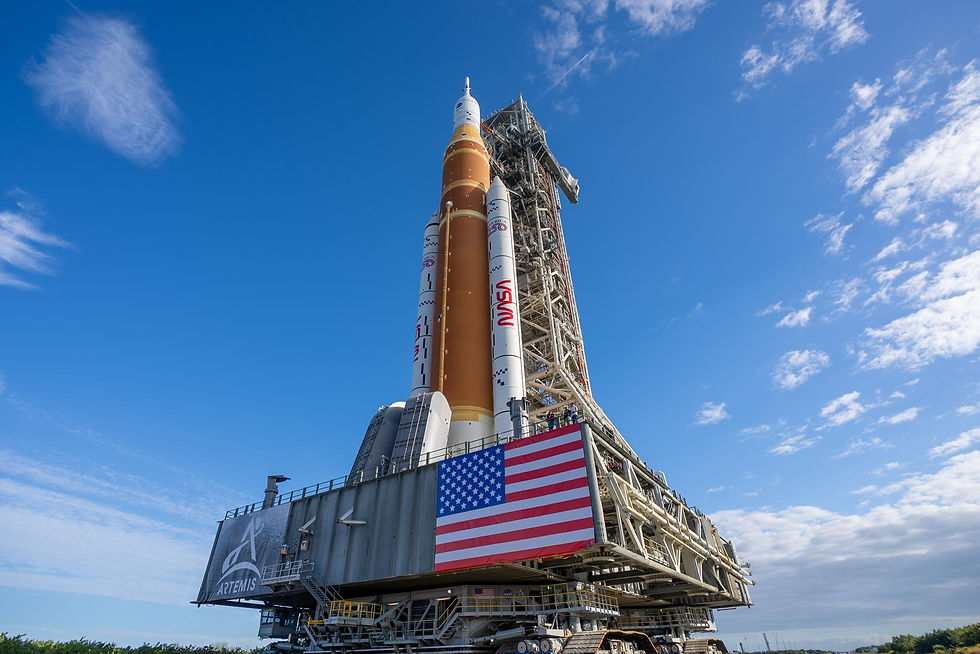
While millions of people watched NASA’s Artemis II mission light up the sky, few may have realized that critical components of that rocket were built just a short drive from Loveland.
At a facility in Mason, engineers and technicians with L3Harris Technologies have spent years helping design and produce avionics systems—the “brains” of the rocket—that played a central role in getting the mission off the ground safely.
According to Jake Hendrickson, Space Avionics Chief Engineer at L3Harris, the company’s involvement in the program dates back nearly two decades, to the early days of NASA’s Constellation program in 2007. What began as work on the Ares rocket eventually evolved into today’s Space Launch System (SLS), the powerful launch vehicle behind the Artemis missions.
From the Mason facility, the team contributed avionics across multiple parts of the rocket. In total, 39 avionics units were used on Artemis II, spread across the twin solid rocket boosters, the massive core stage, and the upper stage developed by United Launch Alliance.
Put simply, avionics systems control and monitor the rocket throughout its flight.
“It’s really the brains of the launch vehicle,” Hendrickson said. “We’re commanding and controlling each stage, collecting data, and making sure everything is operating the way it should.”
Those systems handle everything from steering the rocket’s thrust to managing power distribution and collecting data from thousands of onboard sensors. They also play a critical safety role through the flight termination system—technology designed to destroy the rocket mid-flight if it veers off course, protecting people on the ground.
Just as importantly, the Mason-built systems transmit real-time telemetry data back to Earth, allowing engineers to monitor the vehicle’s performance throughout the mission.
A Space Hub in Southwest Ohio

What may surprise many readers is just how extensive the Mason operation is.
L3Harris’ Mason site is a 245,000-square-foot advanced engineering and manufacturing facility employing roughly 900 people. With more than 60 years of experience in space and defense programs, the site has built a reputation for producing high-reliability hardware—with a track record that includes zero mission failures.
The facility brings nearly every part of the process under one roof, from initial design and engineering to manufacturing, testing, and final qualification. That integrated approach allows teams to collaborate closely and maintain strict quality control—critical when building systems that must perform flawlessly in space.
Inside, the operation includes more than 130,000 square feet of manufacturing space, with specialized clean rooms, temperature- and humidity-controlled environments, and in-house circuit assembly and testing capabilities.
The Mason team’s work extends beyond launch vehicle avionics. They are also involved in spacecraft communications, infrared sensor systems, and advanced electronics used across space and defense programs. Their technology has supported decades of missions—including transmitting data from Mars rovers and satellites used in everyday mapping applications.
A Moment of Pride
Despite the highly technical nature of the work, the human side of the mission remains front and center.
Hendrickson described traveling to Florida to witness the Artemis II launch in person, calling it a “once in a lifetime experience.”
“The sound that it makes coming off the pad—you’re probably holding your breath for the first few minutes,” he said. “But once everything goes well, it’s just an incredible feeling. A lot of pride in what we do.”
That pride extends across the Mason workforce, which plays a unique role in the region.
“There’s not many space companies in the Cincinnati area,” Hendrickson said. “This is one place where you can come and work on space missions. Everything we do is just really interesting.”
Local Impact, Global Mission

The Artemis program represents NASA’s next major step in human space exploration, with plans to return astronauts to the Moon and eventually prepare for missions to Mars.
While the astronauts and rocket launches capture global attention, the mission is also a story of local impact—of engineers, technicians, and manufacturers in places like Mason contributing to something much larger.
From clean rooms in southwest Ohio to the vacuum of space, the work being done at L3Harris is helping power the next chapter of human exploration.
And for Loveland-area residents, it’s a reminder that cutting-edge space technology isn’t just something that happens hundreds of miles away—it’s being built right here at home.



Comments